Course Summary
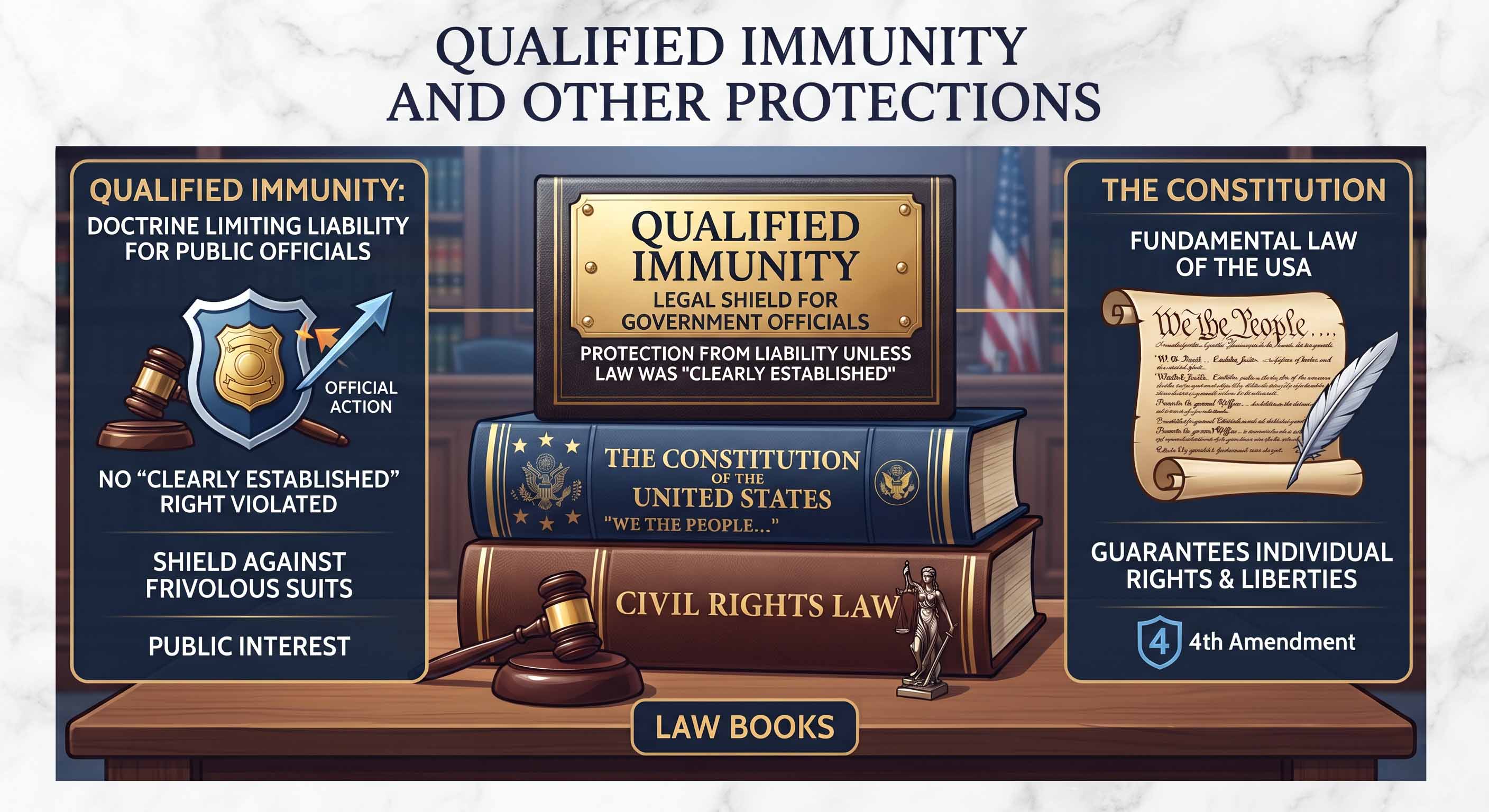
When officers hear that 'qualified immunity may be removed,'
they often translate that into the fear that 'I will personally lose my house.'
This course is designed to separate that fear from the legal reality. The
thesis of this course is that while qualified immunity is important, it is not
an officer's ONLY protection. Furthermore, it is not the same thing as
indemnification, legal representation, insurance, or good constitutional
policing.
We want to set some expectations immediately: this is not
personal legal advice, nor is it advice on how to hide your assets. Instead,
this course focuses on lawful risk reduction, constitutional decision-making,
and knowing exactly which written protections apply to you.
In this course, we will answer the most asked questions
regarding qualified immunity. We will define what it is, what it is not, who
actually pays when a judgment occurs, and how you can become a risk REDUCER.
Our goals are threefold:
- Legal
Clarity. You should be able to explain and understand qualified
immunity without relying on myths, slogans, or overconfidence. - Financial
Realism. You must understand that defense counsel, indemnification,
punitive exposure, and insurance are all separate, distinct issues. - And
Field Behavior. You must identify and use best practices that protect
the case, the agency, the public, and your own personal assets.
By the end of this course, you should be able to:
- Define
a 1983 individual-capacity claim and describe where qualified immunity
fits into that framework. - Distinguish
qualified immunity from agency representation, indemnification, and
insurance. - Identify
conduct that raises personal-risk concerns, such as obvious illegality,
dishonesty, bad faith, and policy deviation. - Apply
a practical checklist for reducing civil-liability and personal-asset
exposure. - Review your own agencys written defense and
indemnification rules.
Course Syllabus
-
Module 1 - Introduction
- Introduction
- The Role of Facts
- Officer Fear vs Legal Reality
- The Liability Stack
- 42 U.S.C. § 1983
- Assessment
-
Module 2 - Case Studies
- Harlow v. Fitzgerald
- Anderson v. Creighton
- Saucier v. Katz
- Pearson v. Callahan
- Malley v. Briggs
- Ashcroft v. al-Kidd and Mullenix v. Luna
- Kisela v. Hughes and Escondido v. Emmons
- Assessment
-
Module 3 - Protections
- Three Protections Officers Often Confuse
- Personal Exposure Risk Ladder
- Asset/Officer Protection Steps - Part 1
- Asset/Officer Protection Steps - Part 2
- Assessment
-
Module 4 - Next Actions
- Supervisor Responsibilities and Role
- Protection Checklist*
- Post-Incident Procedures
- Scenarios - Thinking Exercise*
- Assessment
-
Module 5 - Conclusion
- Admin Procedures vs Criminal Procedures
- Common Officer Questions
- Scenarios - Thinking Exercise*
- Assessment
-
Module 6 - Final Assessment
- Final Assessment